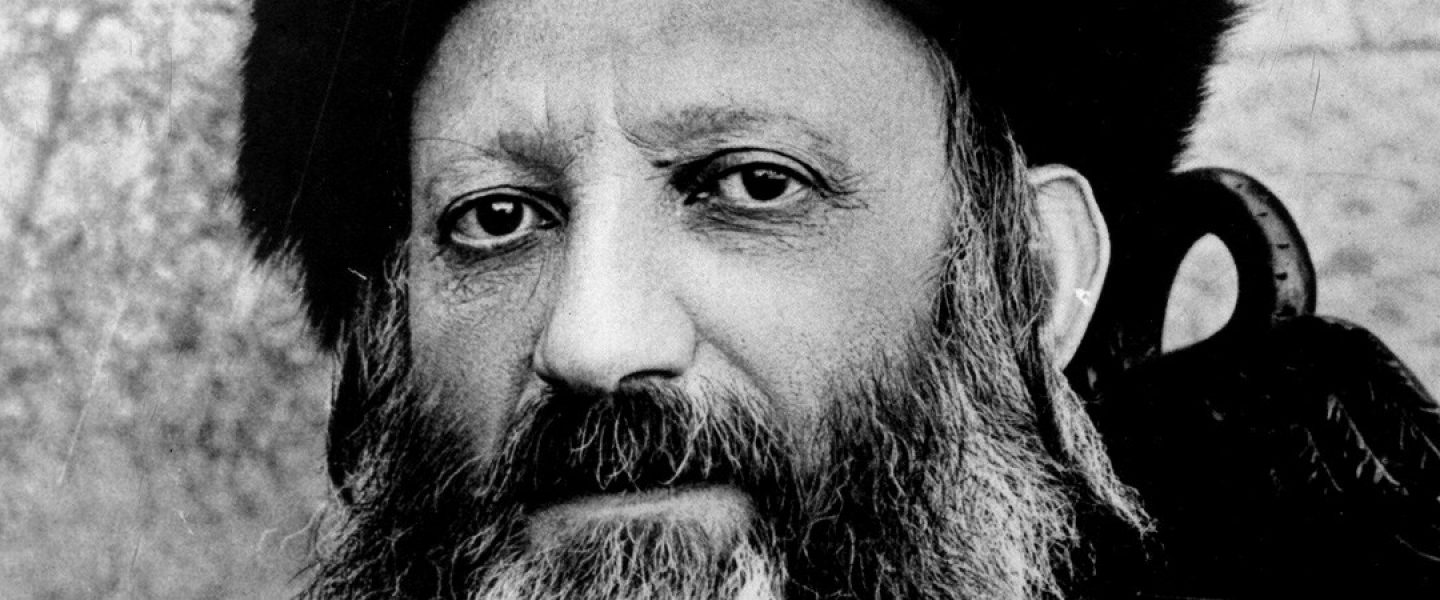
Perfectly Imperfect – Parshat Lech l’Chah

Printable PDF available here. Previous post on Lech l’Chah can be found here and here.

Rav Kook (Olat Re’iah)

And Avram was ninety-nine years old, and G-d appeared to Avram and said to him “I am El-Shaddai; walk before Me and be perfect. And I will place My covenant between Me and between you, and I will multiply you very greatly.” (Bereishit 17:1-2)

What is the meaning of this enigmatic name “El Shaddai”? What exactly does it have to with circumcision, and what can it teach us about our spiritual lives? To answer these questions, we need to step back and address a fundamental issue about the nature of G-d and His relationship with the world. G-d is infinite and transcendent. The created world, no matter how grand or splendorous it seems, will never be able to contain the full degree of Divine majesty. Conversely, any perception of G-d that emerges from the created world is fragmentary and incomplete. This clarifies the spiritual purpose of miracles, when the ‘laws’ of nature are temporarily suspended in order to lift our gaze beyond the narrow confines of earthly existence, and thus remind us of the transcendent Divine reality.

The same dynamic is at work in the covenant of circumcision. The removal of the foreskin expresses the idea that man, like the physical reality in which he lives, cannot unreservedly approach G-d ‘as is,’ under a pretense of perfection and completeness. Ironically, by demonstrating our own incompleteness through brit milah, we make ourselves into a vessel for G-d’s transcendent completeness. We educate ourselves – and the world – that to truly know G-d, we must first admit that our knowledge of Him is imperfect.

These profound truths are encapsulated in G-d’s declaration “I am El Shaddai.” Our Sages taught that means “I am the One whose G-dliness cannot be contained by the world and its fulness” (lit. אני הוא שאין העולם ומלואו כדי לאלוקותי).

Rav Kook (Orot Ha’kodesh II, Pg. 531)

We say that absolute perfection is essential to existence, when nothing will remain in potential but everything will be actualized. However, there is a perfection that consists of the process of increasing perfection.

But that cannot possibly apply to Divinity itself, since G-d’s infinite and absolute perfection allows no room for improvement. To this end – that the process of increasing perfection should not be lacking in existence – a universe must come into being that, in accordance with the goal of increasing perfection, begins from the lowest level. That is to say, it begins from a state of absolute deficiency. And it proceeds by constantly ascending to the absolute height.

Food for Thought

Rav Moshe Weinberger (Song of Teshuva Vol. 4): People generally say that G-d’s objective in creating this world was to have everything completely actualized, in a state of absolute perfection. But Rav Kook states that this is wrong. The highest perfection is the desire to perfect oneself. That, not a static perfection, is the purpose of Creation. The process of gaining perfection is in a certain respect higher than absolute perfection. Had Hashem not created the world with the opportunity for growth, that would have constituted an imperfection. It is precisely because G-d is perfect that He created imperfections. Only an imperfect world can perfect itself – in a constant state of growth and movement. Only because of constant feeling that he is lacking something that he must attain does man have the opportunity to work on himself. By analogy, a true teacher gives each student the ability to be creative and grow. The fact that Hashem made an imperfect world, the fact that He created us with problems and deficiencies that we have to struggle with throughout our lives, is itself an aspect of His perfection. G-d created an imperfect world that reaches toward perfection. That process is in a way greater than perfection itself. All of life is an ongoing process of reaching for these lights, which are always a step beyond us.

Man longs desperately for the unparalleled pleasure that comes with perfecting himself, with rising from one level to another… And so learning Torah gives us the greatest delight, because just as G-d is without end, so is Torah infinite, and as we learn it, we move from smallness to greatness. The happiest day of the year is Simchas Torah. When we finish the Torah, we dance. But we are much more excited about starting over again, this time on a higher level.

Rebbe Nachman of Breslov, in Likutei Moharan (Vol. I, 64) explains that because we are created in G-d’s image, all of our traits and abilities come from the point of Divinity within us. The fact that G-d created and destroyed worlds makes it possible for us to create, experiment, reconsider, and perfect. “Just as Hashem is compassionate, so should you be compassionate” (Sofrim 3:17). Similarly, just as G-d made things, destroyed them, and started again, so too, do we have the capacity to be creative, reconsider, and start over again. Our Sages tell us that the tzaddikim have no tranquility in this world or the next, for they never stop moving even in the world of souls, but keep rising “from strength to strength.” There is always room to improve. There is always a higher level. There is always something beyond a person’s immediate grasp…

Nothing in the world is supposed to remain the way it is. Even a rock was not created to stay as it was made. From the beginning of time, everything is in a constant state of development and perfection, of opening up and rising, spinning towards the final perfection of all worlds, which will be revealed in the future redemption.

Animal Rights Trump Religious Rights (Robert J. Delahunty, 2014): In their contempt for Jewish and Muslim religious practices [of circumcision and ritual slaughter], our contemporary secular liberals are reviving the attitudes of Europe’s pagan, pre-Christian past. The Jews of classical antiquity were chiefly distinguishable, in the eyes of the dominant pagans, by three characteristics: male circumcision; dietary restrictions (especially their refusal to eat pork); and Sabbath observance. Pagan writers ridiculed all three Jewish customs, which of course served to identify the Jews as a people apart. Greeks and Romans regarded circumcision as a physical deformity, and therefore Jews (like those with various other deformities) were banned from the Olympic Games.

Leonard Cohen: Ring the bells (ring the bells) that still can ring/Forget your perfect offering/There is a crack in everything (there is a crack in everything)/ That’s how the light gets in.

The Sacred Rite of Circumcision (Tablet Magazine, 2012): The uproar over circumcision barely conceals a revulsion at the concept of the sacred in all its forms. The German court replaces the Jewish and Christian belief in sanctity of human life and the human body with a perverse concept of rights deriving from bodily proprietorship. In this brave new world, it is legal to bring your grandmother to a Zurich hospital to be euthanized but criminal to bring a newborn boy to be circumcised. It is doubly perverse because the West first learned of human rights, and the rights of newborns in particular, from the Jews. Banish the source of these rights and the notion of rights will eventually turn into a twisted mockery…

But something deeper, and uglier, is at work. The proponents of a ban argue for the right to self-determination—bodily and otherwise. It is perfectly consistent to permit euthanasia, provided that it is voluntary, while banning infant circumcision. The body, in this view, is the property of its owner, who has the right to dispose of it at whim. This argument seems reasonable at first blush, but it crumples with a slight shove… Inalienable rights, as the Declaration of Independence insists, derive from an eternal G-d. The absolute right to live – for the retarded and senile and the newborn as well as the strong and healthy- rests on the mortal human’s share in something eternal. That is the premise of the sacred: The human body whose “physical integrity” so concerns [European courts]… is flawed from the outset, because it will die.

To say that life is sacred means in plain English that our lives belong not to us, but to G-d, so that it is not within our purview to stifle newborns or expose our senile grandmothers. We make something sacred by giving it to G-d and receiving it back from him, as Abraham gave and received his son Isaac. Circumcision of Jewish infants reenacts Abraham’s sacrifice: The infant boy is given to G-d and enters into covenant with G-d, by which we affirm the sanctity of his life. That is the origin of the sanctity of life in human history. The Jewish people have upheld it for nearly 4,000 years…

G-d’s love for Abraham extends to his descendants, and circumcision denotes the transformation of Jewish flesh to a holy vessel for G-d’s presence in the world…. It is sad and empty to think of a human being simply as a lump of flesh seeking pleasure (“sexual self-determination”) and avoiding pain (e.g., through euthanasia) at the behest of its owner. Erase the line between what is sacred and what is merely utilitarian, and there is nothing in principle to prevent us from subjecting “low-value” life to the cost-benefit analysis of the killers [i.e. euthanasia].

Rabbi Jonathan Grossman (Abram to Abraham: A Literary Analysis of the Abraham Narrative): Diverse definitions were offered for the name “El Shaddai.” Most medieval commentators viewed the word Shaddai as an adjective, while most modern biblical scholars see it as a proper noun. The book of Job includes the majority of appearances of the name (31 of 48 in the Bible, not preceded by the name “El”), [and t]he Septuagint translated all [of them] as “the Powerful G-d.”… Alternative name suggestions include deriving Shaddai from שדה (field); linking the term with שדיים (breasts) as a symbol of breastfeeding and abundance; and connecting Shaddai with the Akkadian sadu(mountain)… All appearances of the combination “El Shaddai” in Genesis are linked with the blessing of fertility, supporting the position that connects Shaddai with fertility. Based on this connection an internal link might exist between the revelation of G-d’s new name and the new name given to Avram, which is related to the blessing of fertility bestowed on Abram.

Questions for Discussion

  1. There are two pieces from Rav Kook translated above. Do they give the same explanation for why the created world is necessarily imperfect? If they are different, how so?
  2. What can go wrong when people feel they’re able to approach G-d ‘as is’?
  3. Do you agree with the author of the article in Tablet Magazine that “The [contemporary] uproar over circumcision barely conceals a revulsion at the concept of the sacred in all its forms”? Why or why not?
  4. Where else does the name El Shaddai come up in Bereishit? How are those contexts connected to brit milah?
  5. Rav Moshe Weinberger, commenting on Rav Kook, notes that “Only because of constant feeling that he is lacking something that he must attain does man have the opportunity to work on himself.” How can we cultivate this sense of lacking and avoid becoming complacent in our religious lives?

Of Acronyms and Patronyms – Lech L’chah

large_3J1UnX5eR-qGSsbbYMzqsxAmB4aLh4PpXAmdDt3nayo.jpg

Printable PDF available here

Rav Kook (Ein Ayah, Gemara Shabbat 105a)

Gemara Shabbat 105a: Certain phrases in the Torah can be interpreted as an acronym. This is derived from the verse “Behold My covenant is with you, and you shall become the father of a multitude of nations (lit. אב המון גוים). And your name shall no longer be called Avram, but your name shall be Avraham, for I have made you the father of a multitude of nations (lit. אב המון גוים).” The acronym is:

א– I have made you an אב (father) among nations.

ב– I have made you בחור (chosen) among nations.

ה– I have made you[1]חביב  (respected) among nations

מ– I have made you מלך (a king) among nations.

ו– I have made you ותיק (distinguished) among nations.

נ– I have made you נאמן (faithful) among nations.

As faithful students of the Torah, we know that there’s more to the Written Torah than appears on the surface. Our Sages frequently darshan the text of the Torah for deeper insights. Usually, we pay more attention to what they darshan than how. We’re more focused on substance than form. However, no aspect of Torah is so small as to be insignificant or devoid of meaning. Presumably, there is some correspondence between each deeper derashah of the Torah and the ‘form’ that it comes packaged in. Thus, it is appropriate to ask why the paradigm of acronym derashot is derived from G-d’s promise to Avraham.

To answer this question, we have to define the basic property that makes an acronym unique, compared to other midot she’haTorah nidreshet ba’hen. The distinctive property of an acronym is that every single letter corresponds to a deeper reality. What looks like a word is really a series of icebergs breaking through the surface, concealing an entire world beneath.

And there is no more appropriate expression of this dynamic than G-d’s promise to Avraham in this verse. Granted, Avraham is one our Avot and we refer to him as Avraham Avinu, but his religious influence transcends the Jewish people. He touched the entire world,[2]and affected humanity’s spiritual aptitude in a way that Yitzchak and Ya’akov did not.[3]

In the above teaching, Chazal are not just playing word games. They are identifying six unique dimensions in which Avraham impacted humanity. Avraham was an Av, the source of all true notions of ethics, justice and true knowledge of G-d that humanity would develop. Every spark of holiness in humanity traces itself back to the fire that Avraham kindled.

Avraham’s teachings were also Bachur, select and distinct. Although his message would spread to hostile and impure environments, where it would be buffeted by the dregs of paganism and confused belief, Avraham’s teachings remain pure and fundamentally untainted. Furthermore, Avraham was also Chaviv, regarded with respect for the elevated and holy conception of righteousness that he introduced into the world. Avraham’s message is upright and true, and possesses a charismatic and irresistible attraction.

Avraham was also a Melekh. He did not keep his G-dly message to himself, but fought for it against a world that preferred to remain in ignorance and paganism. The power of his G-dly truth was victorious, making Avraham a king over the hearts and minds of humanity.

Additionally, Avraham was Vatik, distinguished for his deeds and character traits. He was not just a religious revolutionary, but a truly good and G-dly person. The fire that he kindled has succeeded in burning away much wickedness, in bringing humanity closer to true goodness and holy righteousness.

Finally, Avraham was Ne’eman, a man of profound and unshakeable faith. As the Torah itself testifies, “He believed in G-d, and G-d counted it as righteousness” (Bereishit 15:6).[4]Avraham’s faith was not simply about negation, about denying paganism, but promoting an affirmative conception of G-d and what He expects from His creations.

Abraham and his radical ideas kindled a nascent spark of faith among the nations. This flame continues to illuminate the paths of many nations, and in the future, it will be elevated into a purer and more refined faith in G-d.

[1]The letters הand ח are often interchangeable in midrashic interpretation.

[2]G-d promised Avraham that his descendants would be as numerous as the stars. Many commentators are bothered that the Jewish people are quite small compared to other nations. Some commentators (Rabbi Jonathan Sacks?) interpret the promise as referring to Avraham’s spiritual descendants, which indeed comprise most of the world.

[3]Indeed, we do not find that G-d ever references a “multitude of nations” in His promises to Yitzchak or Ya’akov. Rivka is told that “two nations” are in her womb. And Ya’akov is promised that “a nation and a קהל of nations” will come from him.

[4]This pasuk is actually very enigmatic, and commentators disagree whether it refers to Avraham or G-d. Rav Kook is assuming like the former.

Food for Thought

Rambam’s Letter to Ovadia the Convert: I received the question of the master Obadiah, the wise and learned proselyte, may the Lord reward him for his work, may a perfect recompense be bestowed upon him by the Lord of Israel, under whose wings he has sought cover.

You ask me if you, too, are allowed to say in the blessings and prayers you offer alone or in the congregation: “Our G-d” and “G-d of our fathers,” “You who have sanctified us through Your commandments,” “You who have separated us,” “You who have chosen us,” “You who have inherited us,” “You who have brought us out of the land of Egypt,” “You who have worked miracles to our fathers,” and more of this kind.

Yes, you may say all this in the prescribed order and not change it in the least. In the same way as every Jew by birth says his blessing and prayer, you, too, shall bless and pray alike, whether you are alone or pray in the congregation. The reason for this is, that Abraham our Father taught the people, opened their minds, and revealed to them the true faith and the unity of G-d; he rejected the idols and abolished their adoration; he brought many children under the wings of the Divine Presence; he gave them counsel and advice, and ordered his sons and the members of his household after him to keep the ways of the Lord forever…Ever since then whoever adopts Judaism and confesses the unity of the Divine Name, as it is prescribed in the Torah, is counted among the disciples of Abraham our Father, peace be with him. These men are Abraham’s household, and he it is who converted them to righteousness.

In the same way as he converted his contemporaries through his words and teaching, he converts future generations through the testament he left to his children and household after him. Thus Abraham our Father, peace be with him, is the father of his pious posterity who keep his ways, and the father of his disciples and of all proselytes who adopt Judaism.

Therefore you shall pray, “Our G-d” and “G-d of our fathers,” because Abraham, peace be with him, is your father…. since you have come under the wings of the Divine Presence and confessed the Lord, no difference exists between you and us, and all miracles done to us have been done as it were to us and to you… Do not consider your origin as inferior. While we are the descendants of Abraham, Isaac, and Jacob, you derive from Him through whose word the world was created. As is said by Isaiah: “One shall say, I am the Lord’s, and another shall call himself by the name of Jacob” (Is. 44:5).

Rabbeinu Asher b. Yechiel, a.k.a. Rosh, 1250-1327 (Responsum, כלל טו סימן ד): For ketubot and gittin of converts, the custom is to write “So and so, the son of Avraham.” [And even though the convert may not be a biological descendant of Avraham,] the verse says “I have made you the father of a multitude of nations.” And so Avraham is the father of all.

Questions for Discussion

  1. In this piece, Rav Kook discusses reading parts of the Torah as an acronym. What are some other ways the Torah can be read to provide deeper lessons?
  2. What was distinct about Avraham Avinu as compared to Yitzchak and Ya’akov?
  3. Where in the parshah do we see Avraham having a positive impact on the society around him?
  4. Do Christianity and Islam have anything to do with Avraham’s role as a father to a “multitude of nations”? (Take a look at the Rambam in the end of Hilchot Melachim for a fascinating perspective.)
  5. Rav Kook claims there is a connection between the inner message of a Torah teaching and the form it is conveyed in. Do you agree? Why or why not?
  6. Some modern thinkers like to lump Judaism, Islam and Christianity together as “Abrahamic monotheism.” Do you agree with this categorization or think it’s helpful? Why or why not?
  7. Are Jews supposed to emulate Avraham’s role as an אב המון גוים? If so, how?

The Challenge of Nationhood – Parshat Lech l’Chah

Translation: Midbar Shur (Parshat Lech l’Chah)

“And G-d appeared to Avram and said to him… ‘Go before Me and become complete (lit. תמים). Your name will no longer be called Avram. Avraham will be your name, for I have made you the father of a multitude of nations.” [1]

Our forefather Avraham was initially a citizen of Aram and worked diligently for their welfare, as is appropriate for any citizen of a country. When Hashem appeared to him and said “Go before Me,” He was exhorting Avraham to broaden his horizons and further Hashem’s purpose for the entirety of creation. G-d was telling him “Become complete [2] in going before Me, without a heart divided between special loyalty to one’s nation and lesser concern for others. Seek the welfare not just of your Aramean countrymen, but of all of humanity, for that is My objective.”

After all, there is no fundamentally sound reason for an individual to pursue the advancement of any particular nation exclusively, even one that counts him among its members. However, this does not mean a vigorous and special concern for one’s own nation is unacceptable – only that nationalism should not be an end of itself, but rather a means of benefiting all of humanity.

This is why it is at this specific point that Hashem tells Avraham “Your name will no longer be called Avram,” a name which means ‘father of Aram.’ G-d raised Avraham above the social convention of simplistic nationalism, which arbitrarily dictates a special concern for one’s nation over others, and is not founded upon pure virtue.[3] Rather, “Your name is Avraham, because I have made you a father of a multitude of nations.”[4] You shall be a father to all of them, the entire human race, and are charged with seeking their welfare.[5]

It was precisely through this universal mission that Avraham’s descendants would be definitively set apart from the rest of the world. The Jewish people are separated from the other nations in order to maintain the level of purity required to benefit the rest of humanity. Without this separation, we would not be able to serve as a beacon of Divine light to the world.

Commentary

This is our first introduction to Rav Kook’s views on one of the most important subjects of Jewish thought – the relationship between Israel and the other nations, and the ramifications of G-d’s choice of Israel on the stature of the rest of humanity. Rav Kook writes that every nation is precious in G-d’s eyes. The Jewish people are meant to be a “kingdom of Priests”[6] that ministers to all humanity, serving as a role model and source of spiritual inspiration. Jews and non-Jews alike are all ultimately charged to work toward the same goal, albeit with different tools and different paths.

This position contrasts strongly with the understanding (most strongly emphasized in kabbalah and Chasidut) that G-d’s choice of the Jewish people was and is a rejection of the rest of humanity. Although this is not the forum for a comprehensive overview of the complexities of bechirat yisrael,[7] at the very least this piece in Rav Kook reminds us that things are not as simplistic as we might have thought (or been taught). Choseness and universalism are not necessarily a contradiction. According to Rav Kook, the reason we were set apart is precisely so that we are able to maintain the integrity and spiritual purity of our universal Divine message.

Rav Kook also expresses a strident criticism of simplistic nationalism, i.e. pursuing the advancement of one’s nation exclusively, at the expense of the rest of the human race. This chauvinistic attitude is an ethical failure and a denial of G-d’s concern for all of His creation. This notion was not merely a matter of theory for Rav Kook (1865-1935), who lived in a period characterized by nationalist upheavals and revolutionary movements, and who poured so much of his spirit into Zionism and its revival of the Jewish national spirit. According to Rav Kook, only the Jewish people, given their mission of concern for the rest of humanity, are able to model a healthy and ethically complete form of nationalism.

[1] Bereishit 17:1, 5.

[2] As we will see, Rav Kook understands תמים to mean complete, unblemished. See Vayikra 22:21, regarding korbanot, for a similar usage of the word.

[3] In another passage of Midbar Shur (Parshat Vayishlach), Rav Kook expresses the Torah’s rejection of nationalism far more forcefully. The following is an excerpt from Bezalel Naor’s translation:

The statement of the rabbis concerning Abraham contains a universalist message; it condemns in the harshest terms possible the evil of nationalism. There is a certain convention that has become accepted by practically the entire human race, and that is the right of every nation to aggrandize itself at the expense of other nations. Even supposedly righteous rulers are guilty of having shed blood to bring enhanced material prosperity to their nation, without so much as a thought to the havoc wreaked on surrounding nations. Even though human decency dictates that the individual not pursue success through the destruction of fellow humans, on the national level—so according to conventional wisdom—there is free license to achieve success, come what may. Even those who shun military exploits, are incapable of desiring the success of other nations to the same degree they seek their own nation’s advancement.

The most righteous of individuals would find strange the thought that all human beings be given the same advantage seeing as one God created us in His image. This chauvinist thinking is so ingrained in human nature, that even the great champions of justice defend this notion by saying that the scientific and material development of the world requires that nations compete against one another…. The very thought of nationalism is despicable to God, for He equates all mankind. The goal is to seek the true success of all God’s creations. True justice means that one views with equal concern the advancement of the entire human race.

[4] As Rav Kook understands it, the command to “Walk before Hashem and become complete” is related to the change of Avraham’s name that is delivered several verses later. One might have understood that they are unrelated. See the various interpretations quoted by Rashi on verse 1, s.v. veh’yay tamim.

[5] In Ein Ayah (Berachot 13a), Rav Kook explains that Sarah was charged with the same mission, and had her name changed for the same reason. As Rashi (Bereishit 17:15) explains, Sarai means “my princess,” whereas Sarah is unqualified and means “princess over all.” Avraham was to be a father to all of humanity and Sarah was to be the mother.

[6] See Seforno on Shemot 19:6, one of the primary sources for this understanding of bechirat Yisrael.

[7] An excellent overview of the topic is available here, in the shiurim of my teacher Rav Netanel Wiederblank, and here, in an article by Rav Chaim Eisen.

Questions for Reflection and Discussion

  1. When Rav Kook talks about the Jewish people pursuing the welfare of humanity, what do you think he is talking about? Traveling across the world to build orphanages? Serving as ethical role models? Preaching about morality? Some combination of the above?
  2. According to Rav Kook, the Jewish people are set apart precisely so that they are able to maintain their universal mission. What are some of the difficulties involved in maintaining this balance?
  3. The last few years have witnessed a revival of populist and nationalist political movements, both in the United States and overseas. Would Rav Kook understand this revival as healthy? Why or why not?

About This Piece

This piece was published in Midbar Shur, which is a collection of drashot on the parsha that Rav Kook wrote when he was the rav of Zeimel, Lithuania. Unlike Rav Kook’s later works, Midbar Shur is written in normal (i.e. non-poetic and non-kabbalistic) rabbinic Hebrew. Although the drashot were written in the 1880s, Midbar Shur was not published until 1999. It has not been translated into English, but various excerpts are adapted in the works Gold From The Land of Israel, Silver From the Land of Israel, and Sapphire From the Land of Israel, available here,  here and here.