The Midst of the Community – Parshat Emor

Number of Jews in Israel and worldwide on the rise - reports - The ...

Printable PDF available here.

Rav Kook (Ein Ayah, Gemara Berachot 21b)

[Translation based on Rabbi Chanan Morrison’s “Gold From the Land of Israel”]

You shall not desecrate My Holy Name. I shall be sanctified amidst the children of Israel. I am the Lord Who sanctifies you. (Vayikra 22:32)

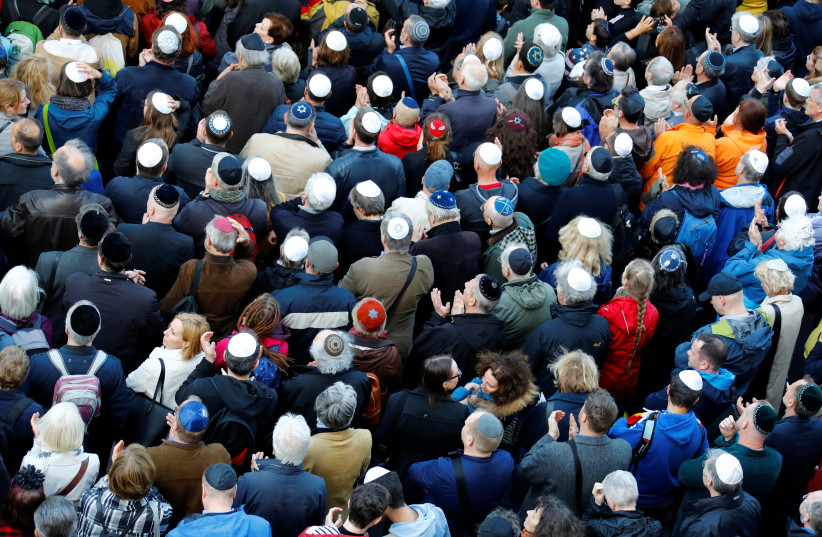
In Judaism, an individual can pray in solitude, but the highest form of prayer takes place in a minyan. Certain special tefilot regarded as a sanctification of G-d’s name (such as kedushah and kaddish) may only be said when ten men are present. Otherwise, these parts of the liturgy must be omitted. The gemara (Berachot 21b) derives the requirement for a minyan from G-d’s declaration in this week’s parshah that “I will be sanctified in the midst (lit. תוך) of Israel.” The gemara notes that this word appears again when G-d warns against Korach’s rebellious band, declaring to the rest of Israel “Separate yourselves from the midst of this eidah (community)” (Bamidbar 16:20). From here, we learn that G-d is sanctified within an eidah, which itself is defined by reference to the ten spies who brought a negative report of the Land of Israel. The Torah refers to that group of ten people as an “eidah ra’ah,” an evil community (Bamidbar. 14:26). Thus, we see that G-d is sanctified in a community of at least ten members.

This is extremely puzzling. First of all, why is the requirement for a minyan, a positive spiritual encounter with the Divine, derived precisely from two classic examples of infamous rebellion against G-d — the spies and Korach? And why is a minyan needed for anything in the first place? Why isn’t prayer an exclusively private matter between a person as his Maker?

To resolve these difficulties, we need to understand the nature of holiness. Holiness can come from our natural aspirations for spiritual growth and perfection. However, the desire to perfect ourselves — even spiritually — is not true holiness. Our goal should not be the fulfillment of our own personal needs, no matter how lofty, but rather to honor and sanctify our Maker. Genuine holiness is an altruistic striving for good for its own sake, not out of self-interest.

Now, the essence of Divine service is to advance G-d’s will, which is to advance the welfare of His creations and to bestow kindness upon them. One who does not join with the community, who does contribute to and uplift its welfare, cannot lay claim to holiness. Therefore, kedushah, kaddish, and certain other prayers may not be said in private. Without a community to benefit and elevate, the individual cannot attain true holiness.

This special connection between the individual and society is signified by the number ten. Ten is the first number that is also a group, a collection of units forming a new unit. Therefore, the minimum number of members for a quorum is ten.

As for why we learn this lesson from the wicked, it is precisely the punishment of the wicked that sheds light on the reward of the righteous. If the only result of evil was that the wicked corrupt themselves, it would be unnecessary for the law to be so severe with one who is only hurting himself. However, it is part of human nature that we influence others and are influenced by our surroundings. Unfortunately, evil people have a negative influence on the entire community, and it is for this reason that they are punished so severely.

Understanding why the wicked are punished clarifies why the righteous are rewarded. Just as the former are punished principally due to their negative influence on the community, so too, the reward of the righteous is due primarily to their positive influence. Now it becomes clear that true holiness is in the context of the organic whole. And certain prayers sanctifying G-d’s Name may only be recited in a minyan, with a representative community of ten members.

Food for Thought

Rav Samson Raphael Hirsch (Commentary on Pirkei Avot): It is not through the individual, but through the community and through the congregation which represent that community on a smaller scale, that Judaism lives on forever. Besides, it was not the Jewish individual but the Kehilath Ya’akov, the Jewish community that God appointed as the bearer of His sacred cause. Therefore the Jewish individual can fulfill his true purpose only in communion with the congregation, and accordingly he is earnestly admonished not to separate himself from the congregation, but to cleave to it in both joy and sorrow, to share its burdens and to help it discharge its tasks.

Rav Samson Raphael Hirsch (Commentary on the Siddur): Thus it is only from the hands of the community that any individual at any time is given his task, and it is only within the framework of his community that he can fulfill it. For the mission reaches far beyond the limited physical, moral and intellectual capacity of the short-lived individual. But a community cannot die; a community can do all things. It is only within the framework of a community that all limitations can be compensated for, that wants can be supplied, and therefore the individual can discharge his task only as part of that community. It is for this reason that only a very few of our prayers were written specifically for individuals; most of them are phrased in the plural form…

Rabbi Jonathan Sacks (Community of Faith:

Rav Samson Raphael Hirsch (Nineteen Letters): It was not with just one word, one summons of creation, that the Almighty brought this world into being [based on Pirkei Avot 5:1], the whole of it and every detail; for if it had been created in this manner, everything would be directly dependent upon G-d’s Word for its existence, life, and functioning. Instead, He called forth His world into existence in ten stages; He created an abundance of forces, intermingled and functioning closely together, according to His Word – and then He separated them, so that each had to sustain the other: none was henceforth able to exist and function by itself, but had to be sustained by its fellow creatures and, in turn, had to help them exist and function. In this way everything contributes according to its strength, however much or little, to the existence of the whole; and if it destroys a fellow creature, it robs itself of what it needs for its own existence.

Questions for Discussion/Further Thought

  1. What other reasons might there be for the concept of a minyan?
  2. Where else in Torah does the centrality of the community express itself?
  3. How can we stay connected to the Jewish community when we are unable to assemble and daven together?
  4. How do we strike the right balance in Jewish life between serving the community and focusing on one’s self?
  5. Can you think of a time that you felt particularly connected to the Jewish community?

Love of Life and the Illusion of Death – Parshat Emor

cohanim_hands_5.jpg

Printable PDF available here.

“And the Lord said to Moses: Speak to the Kohanim, the sons of Aaron, and say to them: Let none [of you] defile himself for a dead person among his people.” (Vayikra 21:1) 

“Any animal [whose reproductive organs] were squashed, crushed, pulled out, or severed, you shall not offer up to the Lord, and in your land, you shall not do it [to castrate any livestock or wild animal, even of an unclean species – Rashi]. (Vayikra 22:24)

  1. Translation (Pinkasei haRei’ah, Vol. 5 pg. 192)

The Kohanim are not merely functionaries in the Temple, but spiritual leaders of the Jewish people, whose influence and spirit models the Torah’s ethical ideals. This is why G-d forbade Kohanim to come into contact with death. This prohibition keeps death away from their consciousness, so that it does not become affected by death and polluted with even the slightest hatred for life. This way, the Kohanim ensure that Torah morality is infused with love of life, which is the purest and most wholesome of man’s natural desires.

Any ethical notion that expresses a hatred or contempt of life is impure and unsustainable. Its only function is as a bitter medicine, which one must take occasionally to prevent a worse sickness from spreading. Other than that, it has no established place in Torah values. The true foundation of Torah morality is love of life.[1]That is because the fullest life is one that is permeated with love for kindness and good, and lived in the light of G-d’s presence.

  1. Translation (Ein Ayah,Shabbat 67b)

Wicked people inflict tremendous destruction upon the world. On the surface, it seems like their destruction is motivated by a vigorous longing to impose their will, and to satisfy the desires of their tempestuous spirit. The truth is that their devastation comes from a deep-rooted hatred of life. And this hatred is a projection of their own spiritual emptiness. In their hearts, the wicked know that they deserve destruction and not life. And so, looking at existence with the same jaundiced perspective that they view themselves, they conclude that the world also deserves to be destroyed.

For this reason, we find that castration of animals was a prominent practice in the pagan world.[2]

  1. Translation (Orot ha’kodesh, 2:280)

Death is an illusion, and its impurity derives from its falsehood. What people lament to as “death” – i.e. passing to the Next World – is really an intensification and amplification of life. Only because of a profoundly shallow perspective, in which the inclinations of man’s heart ensnare him, do we conceive of this passage as a sad and dark matter called “death.”

The sanctity of the Kohanim demands that they transcend the illusion of death and proclaim its falsehood. However, in an imperfect world, the Kohanim cannot abide by this higher truth in the face of a formerly healthy and vibrant body that now lays cold and lifeless. To maintain their higher truth and prevent their spiritual consciousness from being deluded, the Kohanim avert their eyes from the slightest encounter with death.

Commentary and Food For Thought

Rav Kook’s explanation for the prohibition of Kohanim becoming טמא למת is very similar to that given by Rav Samson Raphael Hirsch, in his Commentary to the Torah (Vayikra 21:1): Antique and modem heathenism like so very much to associate religion and religious matters with death and thoughts of death. For them it is where Man ends that the Kingdom of God begins. For them death and dying are the real manifestations of their godhead, who to them is a god of death and not of life. A god who kills and does not animate, and sends death and its fore-runners, illness and wretchedness, so that men should fear him, realize his power and their impotence. The places which they dedicate to temples are therefore round about graves,[3]the foremost place of their priest is therefore at the dead and dying.[4]There, where the light is fading from the eye, and hearts are broken, is the most fruitful field for their religious sowing.

Not so is the Jewish priest because not so is the Jewish teaching of God, the Jewish religion. The God, Whose Name assigns the Jewish priest to his office is a God of life. His sublimest manifestation is the elevating power of Life, freeing, animating, raising Man to free will and to eternal life, not the crushing power of death. Not how one is to die, but how one is to live, how, living, one has victoriously to conquer death, death in life, thralldom, enslaved by one’s physical urges, moral weakness, how one has to live every second of a morally free, thinking, desiring, working and accomplishing life, and also enjoying all the pleasures of life as a moment of service to God, that is the teaching to which God has dedicated His Sanctuary, and for the service of which He has consecrated the Kohanim to care for the “basis of life and direction thereof.”

When Death summons the people to come to busy themselves in acts of love with the empty body of a נפש which God has called home, the Kohanim have to remain away, and by standing away to keep aloft the Standard of Life next to the corpse, and by the thoughts of what life really is, prevent the thoughts of death overpowering the truths that the real Man himself is morally free and not subject to forces which kill his power over his own moral free will. Only where the duties of life call on the priest personally to fulfil the last possible acts of love to the empty shell of the נפש of his wife, child, parent, brother or sister, or where the forsaken state of a corpse makes him to a father and brother of the forsaken one, there his calling as a priest has to retire behind the calling of family and humanity, and his activity with the dead is not only permitted but is a duty. Otherwise priests have to keep away from dead bodies.

Questions for Reflection and Discussion

  1. How can we reconcile Rav Kook’s comments in Sources 1 and 2 above with his comments in Source 3? If Torah morality is rooted in love of life, how can he claim that death is an illusion and really shouldn’t sadden us?[5]
  2. Rav Kook writes that the only place for hatred of life is “as a bitter medicine, which one must take occasionally to prevent a worse sickness from spreading.” What do you think he means? What kind of ‘sickness’ does he have in mind?
  3. How do you think Rav Kook would account for the suspension of the איסור טומאה for a Kohen when it comes to close relatives? What does Rav Hirsch say?
  4. Rav Kook writes that love of life is the cornerstone of Torah morality. What in Torah law or hashkafa can you think of that expresses this value?
  5. How is Rav Kook’s explanation for the prohibition of טומאת מת similar to Rav Hirsch. How is it different?
  6. What can you do to cultivate a greater appreciation of life?
  7. Are you convinced by Rav Kook’s analysis of why wickedness people have destructive urges? Why or why not?

[1]Rav Kook notes that even Moshe Rabbeinu, arguably the most elite spiritual personality of the entire Torah, beseeched G-d to extend his life.

[2]As support, Rav Kook brings a statement in the gemara (Shabbat 67b) that smashing eggs against a wall is prohibited as דרכי האמורי, i.e. pagan superstition. It is not clear whether Rav Kook is drawing on other sources that may indicate a connection between paganism and castration.

[3]In Europe, beginning in the Middle Ages, cemeteries were generally constructed around churches.

[4]Rav Hirsch appears to be referring to the Christian practice of a priest administering last rites.

[5]I think it’s a question of what perspective you adopt, and I think that Chazal themselves were sensitive to this question. See the third chapter of Pirkei Avot– “A single moment of repentance and good deeds in this world is greater than all of the World to Come. And a single moment of bliss in the World to Come is greater than all of the present world.”