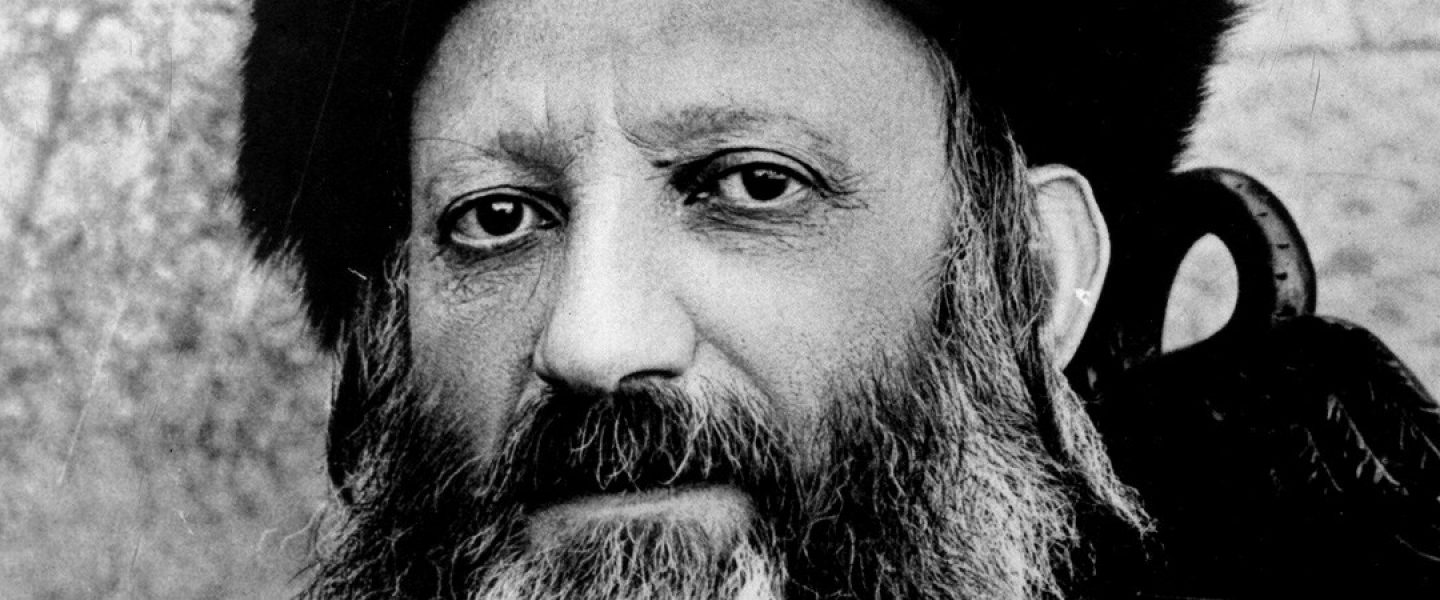
Translation – Midbar Shur, Parshat Noach
The Torah states that “Noach was a perfect tzaddik…Noach walked with Hashem.” [1] Chazal teach that Avraham was on a higher level, as the Torah describes him as walking in front of Hashem. [2] [3] This has to be more than just a play on words. What exactly do these terms signify?
We know that at the outset of Creation, Hashem intended man to achieve his purpose in a straightforward and established manner. Adam haRishon sinned and the order of creation changed. However, G-d’s supernal will did not desire an instantaneous repairof everything that had become broken. Rather, the process of rectification would proceed gradually. Humanity would ascend the ladder of perfection in stages (and sometimes descend to prepare the way for later ascents). Only at a later point in history would the highest level of perfection be reached, when “the entire world will be filled with knowledge of G-d” [4], when G-d will “transform all of the nations…to call out in the name of Lord and worship him of one accord.” [5]
In the interim, G-d, who “assigns measure to the spirit” [6], determines how much Divine inspiration manifests in each generation to spur humanity to its ultimate perfection. As Chazal teach, “Even ruach ha’kodesh rests on the prophets in precise measure (lit. במשקל).” [7] The same goes for every illumination of ruach ha’kodesh and Divine wisdom, regarding how much it is able to express itself and how much its effects are felt in a particular generation.
From the time of Adam’s sin until the Torah was given, humankind was in a lowly spiritual/educational state. The Torah’s light could not be revealed in its totality, but only according to what humanity was able to receive. Even so, the world still contains within it the potential for emerging to a higher state, at a time when it will be able to receive the fullness of the Torah’s light. It follows that there are two possible approaches to the path one charts for himself and others. One is to take measured steps, according to the appropriate spiritual level and situation of the moment in history, without striving to accelerate the world’s movement tothe highest spiritual perfection. The other is to raise yourself and your contemporaries to a level beyond what your generation is prepared for, to lay the foundations for bringing that perfection even closer.
The first level is referred to as ‘walking with G-d,’ and is in accordance with the process that G-d has arranged in nature and history. Although every generation lays the foundation for the spiritual advancement of its successors, this approach is fundamentally focused on the measure of Divine light that manifests in its own specific generation. One who ‘walks with G-d’ is concerned only with his generation’s incremental movement toward perfection.
However, the second level, which is referred to as ‘walking ahead of G-d,’ is concerned with future generations as well. It does whatever it can to accelerate the world’s movement to the highest levels of spiritual perfection.
Chazal are not just making a play on words, but perfectly encapsulating the difference between Avraham and Noach. Noach was תמים בדורותיו, perfect in his generations. He did was was good and upright according to the level of his generation, but was not concerned with advancing the world’s spiritual state. In contrast, Avraham taught righteousness to everyone he came in contact with and did everything possible to bring more Divine light into the world. [8] Perhaps this is why Chazal teach us that “Avraham kept the entire Torah before it was given.” [9] Although the world was not ready for the Torah, which hadn’t even been given, Avraham did what he could to bring the spiritual perfection of the future. He walked ahead of Hashem.
This explains why Avraham, who reached this higher level of perfection and Divine holiness, is the rock from which the עם סגולה of the Jewish people were hewn.
[1] Bereishit 6:7
[2] Bereishis 17:1, 48:15
[3] Midrash Tanchuma, Parshas Noach, cited by Rashi on 6:7
[4] Yeshaya 11:9
[5] Tzefania 3:9
[6] Iyov 28:25
[7] Vayikra Rabba 15:2
[8] See Netziv’s explanation to Sefer Bereishit, where he discusses Avraham’s concern for the wellbeing (physical and spiritual) of even the idolatrous members of his generation.
[9] Gem. Kiddushin 82a. According to Rav Kook, Chazal are being very precise when they identify Avraham (and not any of the other Avot) as keeping the Torah before Sinai. It was Avraham in particular who epitomized this trait of walking in front of Hashem. See also Shut Rama 10, who makes the radical suggestion that the other Avot did not keep the Torah before it was given. I am not sure that Rav Kook would go so far.
Questions for Reflection and Discussion
- Who do I know that embodies the trait of Avraham of ‘walking with G-d’, as described by Rav Kook?
- What causes and accomplishments are the Jewish people disproportionately known for that reflects our being descended from someone who walked with G-d? (Hint – think Nobel prizes, humanitarian causes and/or social justice movements.)
- What does the Torah tell us about Noach that fits with Rav’s Kook’s description of someone not focused on accelerating the spiritual state of his generation? What about Noach’s name supports that description? What about the 7 Noachide laws, as contrasted with the 613 commandments?
- What else does the Torah tell us about Avraham that indicates how he walked ahead of G-d, as understood by Rav Kook?
- From this piece, it sounds like walking ahead of G-d is a good thing. Could it ever be bad? Is there such a thing as walking too far ahead?
About This Piece
This piece was published in Midbar Shur, which is a collection of drashot on the parsha that Rav Kook wrote when he was the rav of Zeimel, Lithuania. Unlike Rav Kook’s later works, Midbar Shur is written in normal (i.e. non-poetic and non-kabbalistic) rabbinic Hebrew. Although the drashot were written in the 1880s, Midbar Shur was not published until 1999. It has not been translated into English, but various excerpts are adapted in the works Gold From The Land of Israel, Silver From the Land of Israel, and Sapphire From the Land of Israel, available here, here and here.
